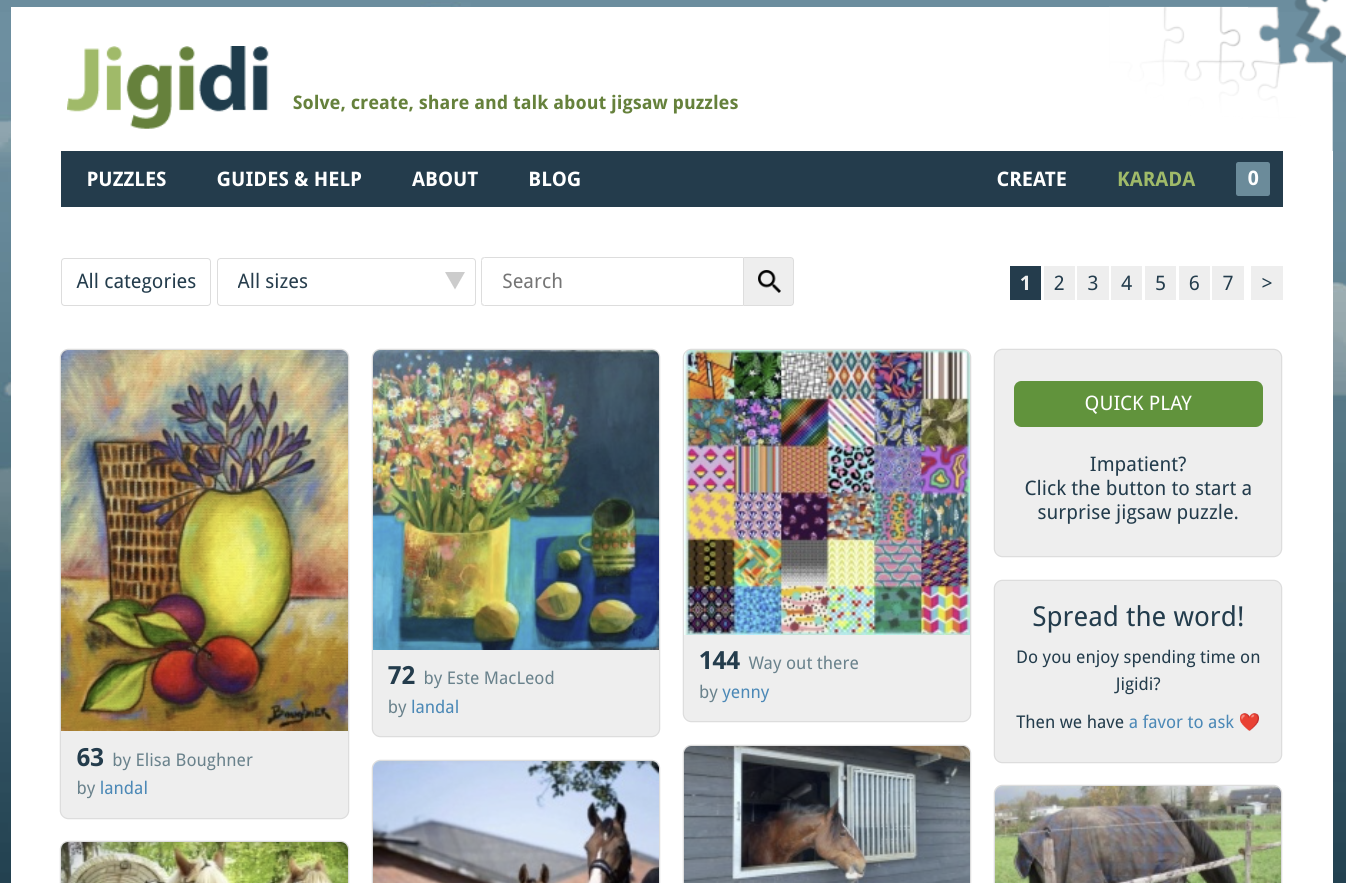
If you are one of those people who enjoy making jigsaw puzzles, then here is one word for you: Jigidi. An online puzzle producing company created in Denmark in 2007. A family-owned business, run by Magnus and Mette. In the beginning it had of course just a few active users, but it has grown a lot since those days. Maybe something for you as well?
Let’s hear what the creators say about this plentiful site:
“Jigidi is a free online community for jigsaw puzzle lovers from all over the world. A jigsaw puzzle community that runs on curiosity, creativity and kindness. Together we build our brain health, share our creativity and connect with each other across all kinds of borders and barriers. The overall purpose for Jigidi is to create a fun and creative growth community for the individual while growing the common ground worldwide (yes, this can be done ♥)”
You can easily make puzzles of your own and share them with the rest of the world. You choose the topic and the size of of the puzzle (i.e. how many pieces you want it to contain). You can also add a message for the solver. There are good instructions in Jigidi of how to go about creating a puzzle. Offensive material is not published. This is family fun!
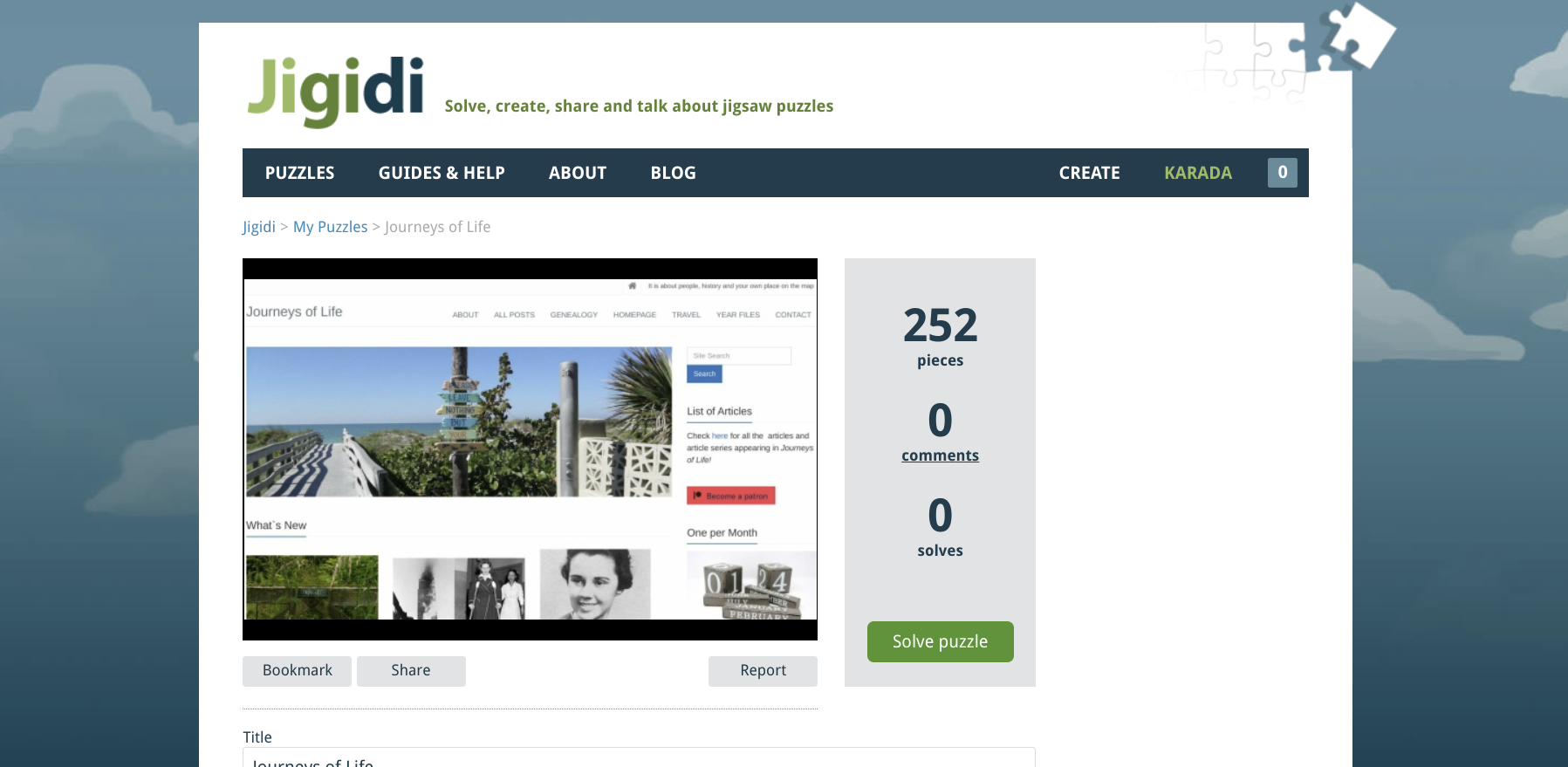
Here is one that I made the other day, of the frontpage of Journeys of Life. You can see the number of pieces it contains (252), but before you come to this page, you have a whole lot of options to choose from as to what kind of puzzle you are looking for. The largest puzzles contain up to 600 pieces. A lot of people like to do the large puzzles, many like the ones having a certain theme, like people, buildings, machinery, nature, movie posters, etc.
But okay, since we are in Journeys of Life that likes to concentrate in history behind people, events, phenomena etc, let’s look at jigsaw puzzles more closely. According to Wikipedia, the British cartographer and engraver John Spilsbury is believed to have produced the first jigsaw puzzle in 1766, using a marquetry saw. He created it as an educational tool to teach geography, affixing a world map to wood and carving each country out to create the first puzzle. Sensing a business opportunity, he created puzzles on eight themes - the World, Europe, Asia, Africa, America, England and Wales, Ireland, and Scotland.
Then, cardboard jigsaw puzzles started appearing in the late 1800s. But they were slow to replace wooden ones. Why? Well, they could be seen as low-quality, and you could make a bigger profit by selling wooden jigsaws.
Most modern jigsaw puzzles are made of paperboard as they are easier and cheaper to mass-produce. For many of us, the bigger the better! But having the pieces on your livingroom table leaves less (if any) room for anything else. But the puzzle maker don’t mind! How good then (for the others) that some libraries provide a table for making puzzles. You can join in with other puzzlemakers in making a huge puzzle, and marvel at the end result together - if you manage to finish it before closing time that is.
And then we come to the online jigsaw puzzles, like Jigidi. Where you construct the puzzle on your desktop by the touch of the mouse. As long as the mouse moves smoothly, you are in for a treat as there are so many puzzles to choose from , and it is all free of charge. But of course, it is always a good idea to become a patreon of a site that you frequent a lot, and thus support its growth to become even better!
Do you know how big the world’s largest-sized puzzle is? It contained 21,600 pieces, and measured 5,428.8 m2 (58,435 sq ft), each piece measuring a Guinness World Records maximum size of 50 cm by 50 cm. This giant puzzle was assembled in 2002 by 777 people at the former Kai Tak Airport in Hong Kong.

Oh, one more thing about puzzle pieces. You may have noticed that the logo of Wikipedia is a globe made out of jigsaw pieces. This incomplete sphere symbolizes the room to add new knowledge. Clever!