Anyone born outside of the United States or Canada tends to underestimate the number of place names in Northern America that have a connection with Native Americans. Or the First Nations as they are called in Canada. They are many! For there have been so many native tribes. Many of them ring a bell with most of us, some are less known, many are either extinct today or are so little known that we just don’t recognize them.
But the fact is that many of the tribes - apart from living their lives in the modern world - live on as names of places allover the Northern, Central and Southern America. This articles deals with place names in the first mentioned.
Just to give you an idea, these U.S. states are named for a Native American tribe: Alabama, Idaho, Illinois, Iowa, Kansas, Kentucky, Massachusetts, Minnesota, Mississippi, Nebraska, New Mexico, North Dakota, Ohio, Oklahoma, South Dakota, Texas, Utah, Wisconsin and Wyoming (19).
And countless towns and cities. Many state names originate in the major river flowing there; the Native American name for the river itself or the activities surrounding it were taken as the state name, but changed a bit and over time for easier spelling and recognition.
Here follows an alphabetical list of the etymology of some of these place names. For a much more complete list, see here (United States) and here (Canada). And, as opposed to many of the other articles in Journeys of Life, there are plenty of links here in order to help further study.
ALABAMA, United States. The state of Alabama is named for the Alabama people, a Muskogean-speaking tribe. Sources disagree on the word’s original meaning. Some scholars suggest the word comes from the Choctaw alba (plants/weeds) +amo (to cut/trim/gather).
BRANTFORD, Ontario, Canada. Named after the Mohawk leader Joseph Brant.
CANADA - This name is derived from the Huron-Iroquois word kanata, which means village. But the French explorer Jacques Cartier who had sailed along the Saint Lawrence River and met with the natives around Island of Montreal, incorrectly interpreted the word as the native term for the newly discovered land.
CHATTAHOOCHEE, Florida, United States - The name Chattahoochee is thought to come from a Muskogee (also known as Creek) word meaning “rocks-marked” (or “painted”), from chato (rock) + huchi (marked). This possibly refers to the many colorful granite outcroppings along the northeast-to-southwest segment of the Chattahoochee river.
CHATTANOOGA, Tennessee, United States. The first part of the name derives from the Muskogean word chato (rock) and the latter may be from a regional suffix -nuga meaning dwelling or dwelling place. It is also believed to be derived from the word Chat-to-to-noog-gee, meaning ‘rock rising to a point’, which is speculated to be a reference to Lookout Mountain.
CHESAPEAKE, Virginia, United States. The word Chesapeake comes from the Algonquian word Chesepiooc (at a big river). The name may also refer to the Chesapeake people/Chesepian who occupied an area that is now the Norfolk, Portsmouth, Chesapeake, and Virginia Beach areas.
CHEYENNE, Laramie County, Wyoming, United States. The city of Cheyenne is named of course for the Cheyenne people.
CHICKAMAUGA, Walker County, Georgia, United States. The name chickamauga comes from the tribe inhabiting the area. Before the 1800s, the Chickamauga Cherokee settled around Chickamauga Creek, where they farmed and hunted the lands. They stayed there until their forced exodus during the Trail of Tears (1838).
CHICOPEE, Hampden County, Massachusetts, United States. Named after the Chicopee River. Chicopee is derived from the Nipmuc language, probably from the words chekee (violent) and pe (waters) in most Algonquian dialects, with reference to rapids. The Nipmuc are the indigenous people who occupied this area before the arrival of European colonists. Alternatively, the name of this city may come from chikkuppee (of cedar), the adjective form of chickkup (cedar).
COQUITLAM, British Columbia, Canada. The name of this city comes from Kwikwetlem (red fish up the river), a Coast Salish word. The Coast Salish people have lived in this area since at least 9,000 years.
DAKOTA (North&South), United States. The name dakota or dakhóta comes from the Sioux word for “friend” or “ally”. The major tribes in the region were the Mandan, Hidatsa, Arikara, Sioux (including Dakota and Lakota) and Chippewa.
ETOBICOKE, Toronto, Ontario, Canada. The name derives from the Mississauga word wah-do-be-kang (place where the alders grow). This was how the area between Etobicoke Creek and the Humber River was described. Augustus Jones, the first provincial land surveyor, also spelled it as “ato-be-coake.” Etobicoke has been the official name since 1795.
FORT ERIE, Niagara Region, Ontario, Canada. The name of the town comes from the Iroquoian word erige (cat).
GOTEBO, Kiowa County, Oklahoma, United States. Named after the well-respectedKiowa Indian named Gotebo (1847-1927). He was one of the first Kiowa baptized at the Rainy Mountain Church.
HACKENSACK, New Jersey, United States. Dutch derivation of the Lenape word Ack-kinkas-hacky. Other spellings: Achkinhenhcky, Achinigeu-hach, Ackingsah-sack which all mean either place of stony ground or mouth of a river. The Lenape people in Hackensack spoke the Unami dialect, one of the two major dialects of the Lenape, or Delaware, languages, which were part of the Algonquian language family.
IDAHO, United States. The origin of the name Idaho remains a mystery. It was claimed to be derived from a Shoshone term Ee-dah-how (Behold! The sun comes from the mountains!), but this appears to be a fabrication. An alternative etymology attributes the name to the Plains Apache word ídaahę́ (enemy) that was used in reference to the Comanche.
ILLINOIS, United States. The word for the state of Illinois has interesting etymology. It derives from the Miami-Illinois verb irenwe·wa (he speaks the regular way). This became modified in the Ojibwe language as ilinwe· (pluralized as ilinwe·k). The French colonists borrowed these forms, spelling the /we/ ending as -ois, a transliteration of that sound in the French of that time, and the current spelling form, Illinois, began to appear in the early 1670s.
IOWA, United States. The state of Iowa derives its name from the Ioway people. Their name has been said to come from the Sioux word ayuhwa (sleepy ones). Early European explorers often adopted the names of tribes from the ethnonyms that some other tribes gave them. The Ioway people called themselves Bah-Kho-Je (grey snow).
KANKAKEE, Illinois, United States. The city’s name is probably derived from the Miami-Illinois word teeyaahkiki (open country/exposed land/land in open/land exposed to view). There is Kankakee also in Indiana, which took its name from the nearby Kankakee River.
KANSAS, United States. Kansas is named after the Kansas River, which in turn was named after the Kansa (or Kaw or Kanza) tribe that lived along its banks. The tribe’s name (natively kką:ze) is often said to mean “people of the (south) wind” although this was probably not the term’s original meaning. Their tribal language is Kansa, classified as a Siouan language.
KENTUCKY, United States. Kentucky is named for the Kentucky River. The precise etymology of the name Kentucky is uncertain. It is likely from an Iroquoian name meaning “(on) the meadow” or “(on) the prairie. But some researchers suggest it comes from an Algonquian language, possibly derived from Shawnee as Kenta Aki (Land of Our Fathers). In Ojibwe it translates as “Land of Our In-Laws”.
KISSIMMEE, Osceola County, Florida, United States. The name Kissimmee can be traced back to the language of the Jororo people and means “long water.” There were approximately 350,000 people living in Florida when the Spanish arrived in 1513.
KLONDIKE, Yukon, Canada. The name Klondike evolved from the Hän word Tr’ondëk (hammerstone water). Early gold seekers found it difficult to pronounce the First Nations word, so “Klondike” was the result of this poor pronunciation.
KOKOMO, Howard County, Indiana, United States.The settler tradition says Kokomo was named for Kokomoko or Ma-Ko-Ko-Mo (black walnut). He was said to have been one of the four sons of Chief Richardville, last of the chiefs of the Miami people. David Foster, known as the “Father of Kokomo,” claimed that he named the town Kokomo after the “ornriest Indian on earth” because Kokomo was “the ornriest town on earth.” Kokomo is thought to have been born in 1775 and died in 1838.
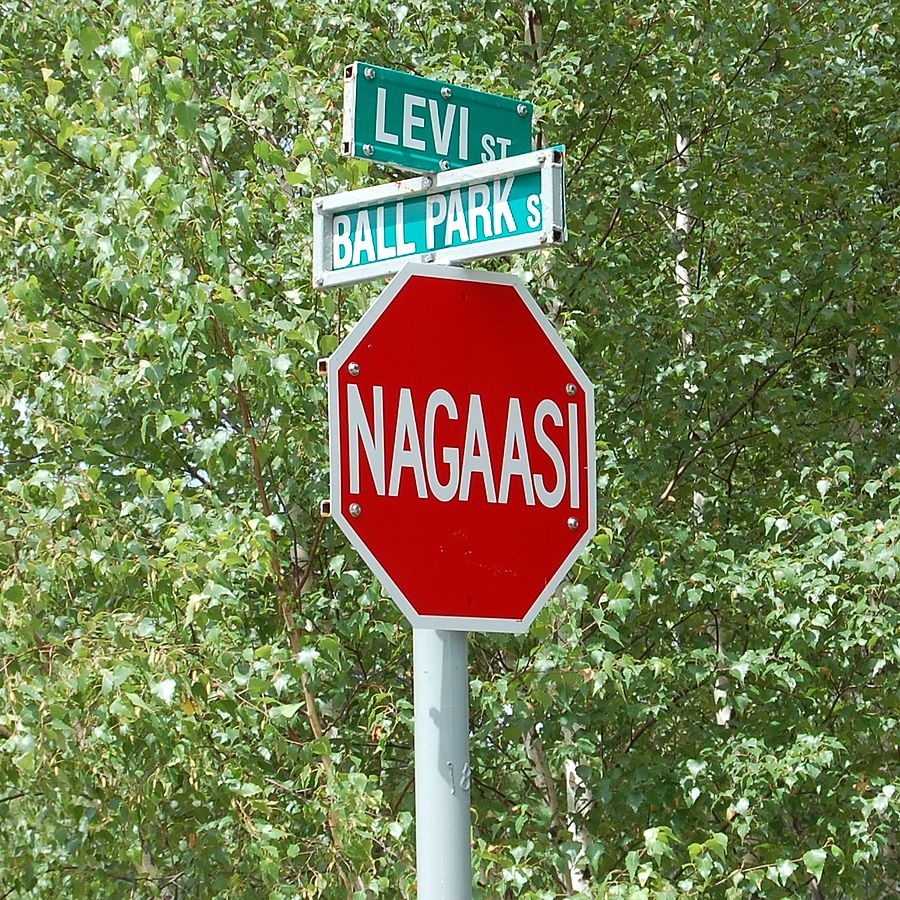
Miꞌkmaq-language stop sign
MAGAGUADAVIC LAKE, New Brunswick, Canada. Magaguadavic is a Mi’kmaq word meaning “lake of eels”.
MALAGASH, Nova Scotia, Canada. The name comes from the Mi’kmaq word that translates as the “land of games”.
MALIBU, California, United States. Malibu is named for the Ventureño Chumash settlement of Humaliwo (The Surf Sounds Loudly).
MANATEE COUNTY, Florida, United States. The word Manatee in the Manatee County comes from Taíno word manatí (breast). Manatees - also called sea cow for their appearance - are slow plant-eaters, peaceful and similar to cows on land. Taíno tribe was a pre-Columbian people of the Caribbean.
MANHATTAN, New York, United States. Manhattoe was the name given to the southern tip of the island by the Eastern Algonquian Munsee-speaking Wappinger people who controlled the upper three-quarters of the island as a hunting ground. Over time Manhattoe became “Manhattan” and “Manhattans” to describe both the Native people who hunted there as well as the island itself.
MANITOBA, Canada. This name is believed to be derived from either the Cree, Ojibwe or Assiniboine languages.
Cree: manitou-wapow (straits of Manitou - the Great Spirit)
Ojibwe: manidoobaa (straits of Manitou - the Great Spirit)
Assiniboine: minnetoba (Lake of the Prairie)
MANIWAKI, Quebec, Canada. It is an Algonquin name that means “Mary’s land” - Mani being the traditional Algonquin variant of Mary or Marie, and waki of course meaning land. The Maniwaki Algonquins speak a Southern Algonquin dialect.
MASSACHUSETTS, United States. The Massachusetts Bay Colony was named after the Massachusett whose name likely derived from a Wôpanâak word muswachasut, translated as “near the great hill”, “by the blue hills” (referring to the Blue Hills), “at the little big hill”, or “at the range of hills”. Alternatively, the name might come from Moswetuset. From the name of the Moswetuset Hummock (hill shaped like an arrowhead) in Quincy.
MATTAWA, Ontario, Canada. The word mattawa means “Meeting of the Waters” in the Algonquin language. The area was first inhabited by native people who used the Mattawa River as an important transportation corridor for many centuries.
MIAMI, Miami-Dade County, Florida, United States. Named after the Mayaimi, a Native American tribe that lived around Lake Okeechobee until the 17th or 18th century.
MICHIGAN, United States. The name derives from a gallicized variant of the original Ojibwe word mishigami (large water/large lake). The Ojibwe were the largest of the three tribes living around the Great Lakes at the time when the first European explorers arrived.
MILWAUKEE, Milwaukee County, Wisconsin, United States. The name Milwaukee comes from an Algonquian word millioke (good/beautiful/ pleasant land).
MINNEAPOLIS, Minnesota, United States. A hybrid word combining the Dakota word mní (water) and the Greek polis (city).
MINNESOTA, United States. The word Minnesota comes from the Dakota name for the Minnesota River, which got its name from one of two words in Dakota: “mní sóta” (clear blue water) or “Mníssota” (cloudy water).
Many places in Minnesota have similar Dakota names. Such as
Minnehaha Falls (curling water or waterfall)
Minneiska (white water)
Minneota (much water)
Minnetonka (big water)
Minnetrista (crooked water)
MISSISSAUGA, Ontario, Canada. The name Mississauga comes from the Anishinaabe word Misi-zaagiing (Those at the] Great River-mouth). Closely related to the Ojibwe word Misswezahging (a river with many outlets).
MISSISSIPPI, United States. The state' s name comes from the Missisippi River, named so by the European settlers after the Ojibwe word **misi-ziibi **(great river).
MISSOURI, United States, The state of Missouri is named for the Missouri River, which in turn was named after the Missouria, a Siouan-language tribe. French colonists adapted a form of the Illinois language-name for the people: Wimihsoorita, meaning “One who has dugout canoes”.
NARRAGANSETT, Rhode Island, United States. The land that became the English colony was first home to the Narragansett Indians. European settlement began around 1622.
NEBRASKA, United States. The name of the state of Nebraska is the result of anglicization of the archaic Otoe words Ñí Brásge (flat water) or the Omaha Ní Btháska (flat water), after the Platte River which flows through the state.
NEW MEXICO, United States. The name Mexico derives from Nahuatl, also called Mexicano, which is a language or group of languages of the Uto-Aztecan language family. The name referred originally to the heartland of the Empire of the Mexicas, i.e. the Aztec Empire in the Valley of Mexico.
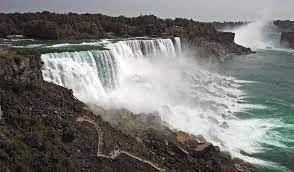
NIAGARA FALLS, New York, United States. Theories differ as to the origin of the name of the falls. Perhaps it is the name that was given to the local natives, the Niagagarega people. Perhaps it comes from the name of an Iroquois town called Onguiaahra (point of land cut in two). Perhaps from the Iroquois word Jaonniaka-re (noisy point or portage).
NIPISSING, Ontario, Canada. Comes from the Ojibwe word niipsing (place of the elms). The area is a long-standing community of Nishnaabeg peoples, who in turn are part of the Anishinaabe peoples, a grouping of people speaking Algonquin languages, which includes the Odawa, Ojibwe, Potawatomi, and Algonquins.
NUNATSIAVUT, Newfoundland and Labrador, Canada. The name comes from Inuktitut (our beautiful land). Nunatsiavut is an autonomous area claimed by the Inuit in 2005.
OHIO, United States. The name of the state of Ohio comes from the Ohio River, whose name in turn originates from the Seneca word ohiːyo', meaning “good river”, “great river” or “large creek”.
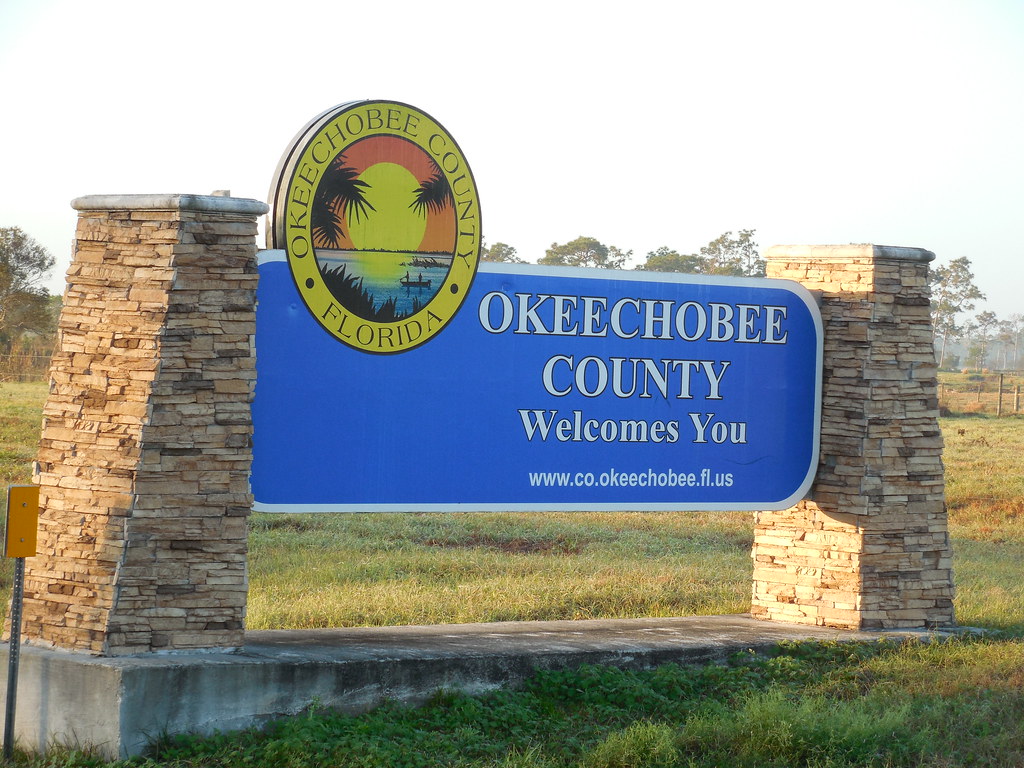
OKEECHOBEE, Okeechobee County, Florida, United States. The name Okeechobee comes from the Hitchiti words oki (water) and chubi (big), referring naturally to Lake Okeechobee. Hitchiti is one of the Muskogee languages, spoken in Georgia and Florida during the Colonial period by such tribes as the Hitchiti, Chiaha, Oconee, Sawokli, Apalochicola, and Miccosukee.
OKLAHOMA, United States. The name Oklahoma comes from the Choctaw language phrase okla humma (red people) from okla (people) + humma (red). In the related Chickasaw language, the state is known as Oklahomma.
OMAHA, Douglas County, Nebraska, United States. The city of Omaha is named for the Omaha tribe, the word Omaha (actually Umoⁿhoⁿ or Umaⁿhaⁿ) meaning “Dwellers on the bluff”.
ONEONTA, Otsego County, New York, United States. While the word oneonta is of undetermined origin, it is popularly believed to mean “place of open rocks” in the Mohawk language. This refers to a prominent geological formation known as “Table Rock” at the western end of the city.
ONTARIO, Canada. The name derives either from
Huron (Wyandot) word Ontarí:io (great lake) or the
Iroquoian word skanadario (beautiful water)
OSCEOLA COUNTY, Florida, United States, Osceola County is named for the Indian leader Osceola whose Creek name Asi Yahola means “Black Drink Cry”. Osceola became an influential leader of the Seminole people in Florida.
OTSEGO COUNTY, New York, United States. The name otsego is from a Mohawk or Oneida word meaning place of the rock.
OTTAWA, Ontario, Canada. The capital city of Canada is named after the Odawa people, and the name of the tribe was adapted from the Anishinaabe language word adaawe (to buy).
OTTUMWA, Wapello County, Iowa, United States. The city’s name derives from Native American Sac and Fox, alternatively Meskwaki, language. The English language translation is generally presumed to refer to the Appanoose Rapids of the Des Moines River, as “tumbling waters” or similar.
OWOSSO, Shiawassee County, Michigan, United States. The city was named after Chief Wosso, an Ojibwe leader of the Shiawassee area.
PENSACOLA, Florida, United States. The name Pensacola comes from the Choctaw name of a Muskogean group, “hair people”, from pashi (hair) + oklah (people).
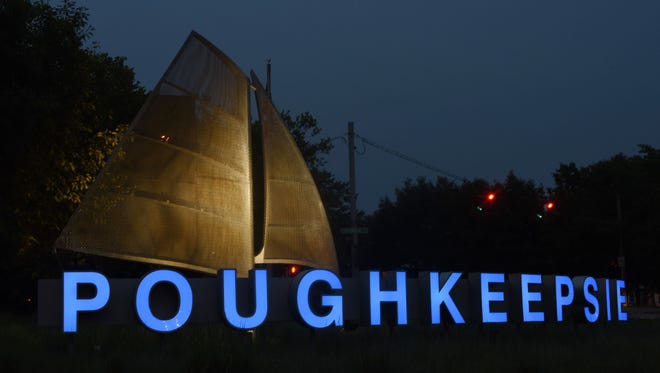
POUGHKEEPSIE, Dutchess County, New York, United States. The name Poughkeepsie is derived from a word in the Wappinger language, roughly U-puku-ipi-sing (the reed-covered lodge by the little-water place)', referring to a spring or stream feeding into the Hudson River south of the downtown area.
PUYALLUP, Pierce County, Washington, United States. The city’s name comes from the Puyallup Tribe, and means “the generous people”.
QUEBEC, Canada. The word Quebec comes from the Míkmaq word kepék,(strait, narrows). The French explorer Samuel de Champlain chose the name Québec in 1608 for the colonial outpost he would use as the administrative seat for the French colony of New France.
RONKONKOMA, Long Island, New York, United States. The name Ronkonkoma comes from an Algonquian expression Raconkumake or Raconkamuck (boundary fishing-lake).
SAGINAW COUNTY, Michigan, United States. The etymology of this county’s name is uncertain. It may be derived from Sace-nong or Sak-e-nong (Sauk land), as the Sauk tribe is believed by some to have once lived there. A more likely possibility is that it comes from Ojibwe word sagong (place of the outlet): sag (opening) + ong (place of).
SASKATCHEWAN, Canada. The word for this Canadian province is derived from the Cree name for the Saskatchewan River, kisiskāciwani-sīpiy (swift flowing river).
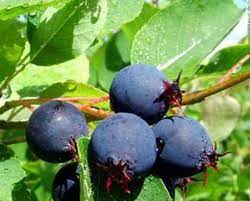
SASKATOON, Saskatchewan, Canada. The name Saskatoon refers either to the Cree word sâskwatôn which comes from the inanimate noun misâskwatômina “saskatoon berries” - the sweet, violet-coloured berry that grows in the area. That is the traditional story behind the name. However, the area was long-known to the local Cree as a good place to stock up on willow wands for arrow shafts. Thus the name of the place was “Sask-kwa-tan” – roughly, “the place where willows are cut”.
SCHAGHTICOKE, Rensselaer County, New York, United States. Named for the Schaghticoke, a Native American tribe formed in the seventeenth century from an amalgamation of remnant peoples of eastern New York and New England. Schaghticoke has various spellings, derived from an Algonquian Dialect-R word pishgachtigok (the confluence of two waterways or “Gathered Waters”).
SEMINOLE COUNTY, Florida, United States. Seminole County is named after the Seminole tribe. The word Seminole is derived from the Muscogee word simanó-li, which may itself be derived from the Spanish word cimarrón, meaning “runaway” or “wild one”.
SIOUX FALLS, South Dakota, United States. The city of Sioux Falls is named for the Sioux Tribe and also for the waterfalls of the Big Sioux River. The lure of the falls has been a powerful influence. Ho-Chunk, Ioway, Otoe, Missouri, Omaha, Ponca, Quapaw, Kansa, Osage, Arikira, Dakota, and Cheyenne people inhabited and settled the region before the Europeans came.
TACOMA, Pierce County, Washington, United States. Tacoma adopted its name after the nearby Mount Rainier, originally and locally called Takhoma or Tahoma.
TALLAHASSEE, Leon County, Florida, United States. Tallahassee is a Muskogean language word often translated as “old fields” or “old town”.
TAMPA, Hillsborough County, Florida, United States. The name Tampa may have come from the Calusa language (sticks of fire) or possibly the Timucua language. Some scholars have compared “Tampa” to “itimpi”, which means “close to or nearby” in the Creek language, but its meaning is not known. Yet another source relates that Tampa comes from a Seminole word for wood.
TEMECULA, Riverside County, California, United States. Temecula is named for the Temecula Indians (“Temeekuyam”) who lived at “Temeekunga” (the place of the sun). Other popular interpretations of the name include “The sun that shines through the mist” or “Where the sun breaks through the mist”.
TEXAS, United States. The name for the state of Texas is probably based on the Caddo word táysha' (friend), which in the mouth of the Spaniards there became teja, and the final -s represents of course the Spanish plural. Both Tejas and Texas are recognized in Spanish as they are pronounced just the same. The English pronunciation with /ks/ however is unetymological.
There is also a theory that the name comes from the Spanish teja (rooftile), the plural tejas being used to designate indigenous Pueblo settlements. Somehow one is inclined to believe in the first theory, the Caddo people perhaps introducing themselves as táysha' (friend).
THONOTOSASSA, Hillsborough County, Florida, United States. The name thonotosassa comes from the Seminole-Creek words ronoto (flint) and sasv (some) - the place was a source of valuable flint. After the Second Seminole War ended in 1842, white people began to settle n the area.
TISHOMINGO, Johnston County, Oklahoma, United States. Named for the Chickasaw leader Tishomingo (c.1735-1837) from the Chickasaw name Tishu Minco ( lit. ‘warrior chief’).
TOPEKA, Kansas, United States. The name of Topeka, capital city of Kansas, is said to be the Kaw (or Kansa) word Tó Ppí Kˀé (a good place to grow potatoes).
TORONTO, Ontario, Canada. The word Toronto is likely derived from the Mohawk word tkaronto (where there are trees standing in the water), which originally referred to The Narrows. The French spelling of Taronto changed later to Toronto. Ramara Historical Society
UTAH, United States. The name Utah is said to derive from the name of the Ute tribe, meaning “people of the mountains”, but more likely it comes from the Apache word Yuttahih (one that is higher up/those that are higher up) which in Spanish was pronounced Yuta. So English-speaking people may have adapted that word as “Utah”.
WACO, Texas, United States. The word Waco comes from the Wichita Indian tribe known as the Waco.
WAPAKONETA, Ohio, United States. Established in the 1780s as a Shawnee settlement called “Waughpaughkonnetta”, The name of the city is possibly derived from the Shawnee word Wa-po’kanite (the place of white bones).
WAUKEGAN, Illinois, United States. Originally Wakaygagh, the residents of Little Fort - proud of the growth of their community and no longer wanting to be characterized as “little” - changed the name of their town in 1849 to Waukegan, which is the Potawatomie word for "fort” or "trading post".
WINNEMUCCA, Nevada, United States. Named for the 19th-century Chief Winnemucca of the local Northern Paiute tribe. Winnemucca means, loosely translated, “one moccasin.”
WINNIPEG, Manitoba, Canada. The city is named after nearby Lake Winnipeg. The English explorer Henry Kelsey, perhaps the first European to see the lake in 1690, adopted the Cree and Ojibwe name **win-nipi **(also transcribed win-nipiy or ouenpig) meaning “murky water” or “muddy water”, modern Cree: wīnipēk. Also, the French-Canadian fur trader La Vérendrye referred to the lake as Lac Gouinipique or Ouinipigon when he built the first forts in the area in the 1730s.
WISCONSIN, United States. The name for Wisconsin originates from the name given to the Wisconsin River by one of the Algonquian-speaking Native American groups living in the region in the 17th century. It was called Meskousing by the French, and later Ouisconsin. English settlers anglicized it to Wisconsin in the 19th century. The origin of the name is probably in the Miami word Meskonsing (it lies red), as Wisconsin River flows through the reddish sandstone. Other theories have a variety of Ojibwa words (red stone place, where the waters gather, great rock) as the origin.
WYOMING, United States. The name Wyoming derives from the Munsee word xwé:wamənk (at the big river flat).
YAKIMA, Yakima County, Washington, United States. The name Yakima originates from the Yakama Nation whose reservation is located south of the city.
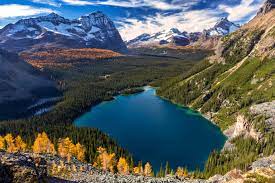
YOHO NATIONAL PARK, British Columbia, Canada. The word Yoho is a Cree expression of amazement or awe. An apt description for the park’s spectacular landscape of massive ice fields and mountain peaks, which rank among the highest in the Canadian Rockies.
YUKON, Canada. The territory is named after the Yukon River, and the word Yukon is from a contraction of the words in the Gwich’in phrase chųų gąįį han (white water river), referring to the pale colour of glacial runoff in the Yukon River. Also, thought to come from an Athabaskan language, e.g. Koyukon yookkene, or Lower Tanana yookuna.
https://en.wikipedia.org/wiki/List_of_placenames_of_indigenous_origin_in_the_Americas
https://www.tandfonline.com/doi/abs/10.1179/nam.1970.18.3.175?journalCode=ynam20
Updated 1.7.2023