
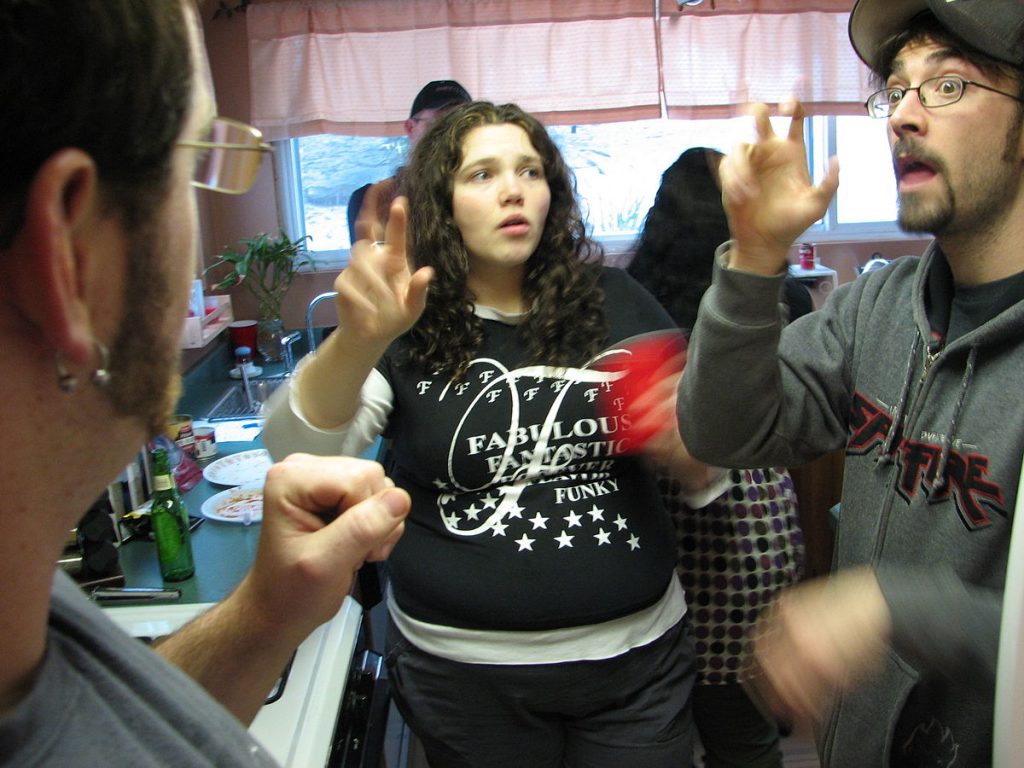
People conversing in sign language. Photo credit Natural American Sign Language by daveynin
This time in Language Day let’s have a look at sign languages. Since many of the ways we show our emotions and reactions with different gesticulations and facial expressions are universal, one might think that there could be just one universal sign language. But that is of course not the case.
Sign languages are expressed through manual articulations in combination with non-manual elements. They are full-fledged natural languages with their own grammar and lexicon.
There can be striking similarities among sign languages, but still they are not universal and not mutually intelligible with each other. Just have a look at these two examples - the Swedish and the Irish sign language alphabets:
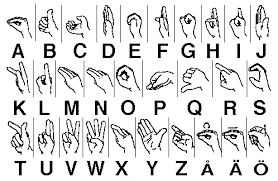
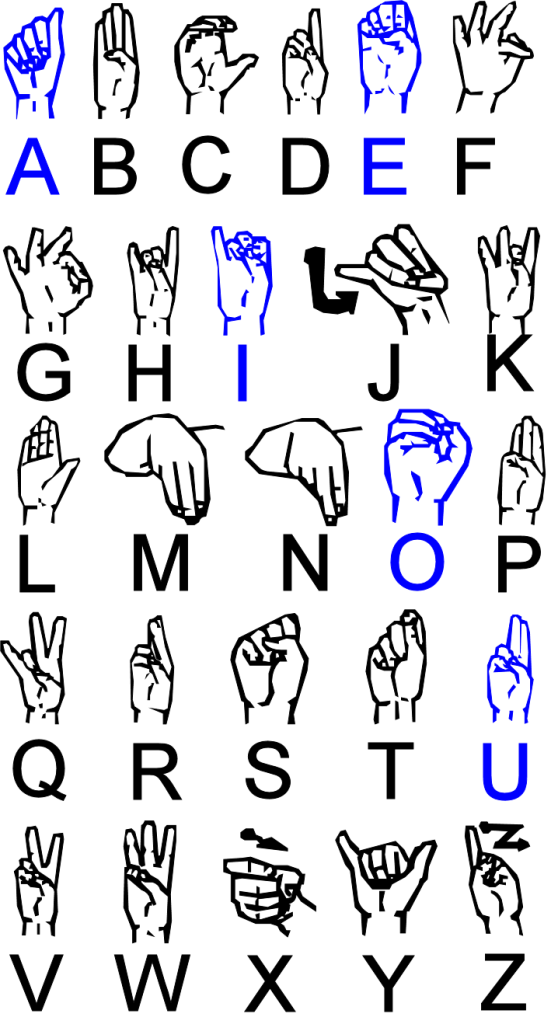
Even if you do see some similiarities, the differences overweigh them. And there is no end to all the local variations of any of the myriad of sign languages.
That doesn’t in any way diminish the fascination we with the normal verbal language background may feel as we watch people communicate in sign language. It’s like watching a secret meeting that you might be able to decipher to a certain extent. And like watching an art performance that takes place in absolute or relative silence. There is the same communication going on that we hearing people have, but with such dimensional differences.
Sign language has become a routine thing that you can see daily by just watching a debate or news broadcast on television that are interpreted in sign language. It can be pretty fascinating to watch how seemingly simple ways even long sentences are interpreted in the rapid information flow of today. The hands and fingers move fast, the facial expressions change off and on all the while as some of the signs may seem almost understandable to the rest of us. It is a fascinating display of human potential!
PS. This article needs further research.