
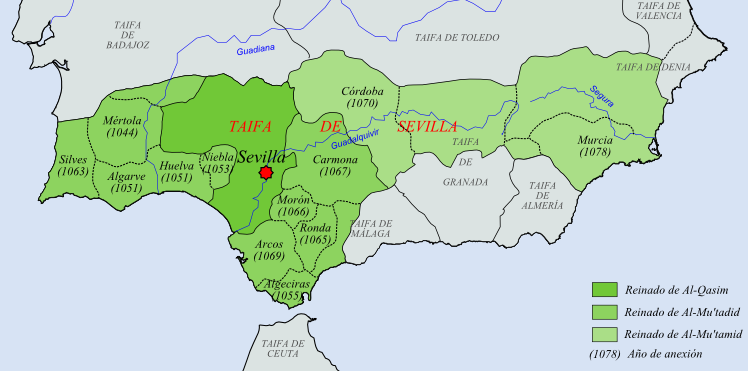
The date is not that exact here either (as is the case with many of these distant events), but sometime during December of 1023, Abbad I, the eponymous founder of the Abbadid dynasty, declares the Taifa of Seville independent from Córdoban rule. Abbad I became the first independent Muslim ruler of Seville in Al-Andalus - the Muslim-ruled area of the Iberian Peninsula - and he stayed in power until his death in 1042.
Following the declaration of independence, Abd ar-Rahman V is proclaimed Caliph of Córdoba. During the following decades, Taifa of Sevillle (Taifa means by the way Principality) grew bigger, and lasted until 1091 in what is today southern Spain and Portugal. Abd ar-Rahman V didn’t last long as a caliph though as he was murdered in January 1024 by a mob of unemployed workmen, headed by one of his own cousins.
The common languages in Taifa of Seville were Arabic, Berber, Mozarabic and Hebrew.